

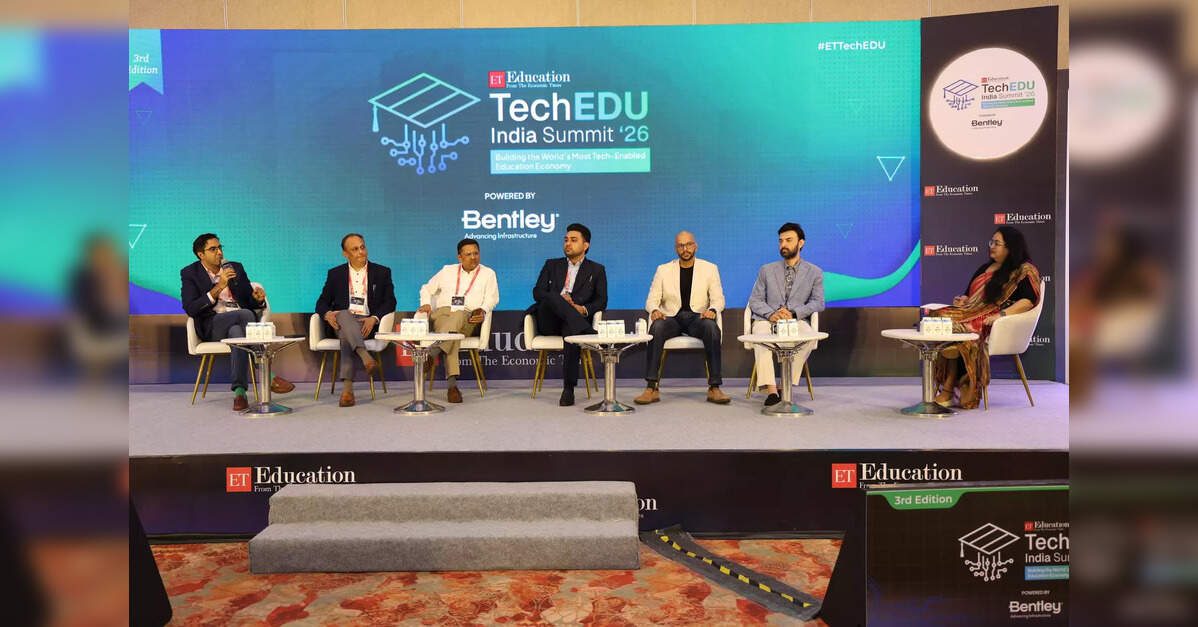
Artificial Intelligence may be the most discussed phrase in higher education today, but across campuses, many initiatives remain confined to pilot projects and innovation labs. That tension formed the core of the discussion at the Economic Times TechEDU India Summit 2026, where academic leaders and edtech executives examined a pressing question: Are institutions truly ready to scale AI beyond experimentation?Moderated by Vaishnavi Desai, Senior Assistant Editor – Emerging Tech, ETCIO & CISO, The Economic Times, the discussion brought together voices from ATLAS SkillTech University, Indian Institute of Creative Technologies, Vidyalankar Institute of Technology, Kalinga University, D2L and Meritto.AI adoption is a cultural shift, not just a technology upgradeSiddharth Shahani, Co-Founder and Executive President, ATLAS SkillTech University, reframed the conversation early on. AI adoption, he argued, is less about infrastructure and more about mindset.“We need our faculty and academic leaders to be early adopters of technology—that’s what will help us move from pilot to scale,” he said, emphasising that institutions must encourage experimentation within classrooms rather than limit AI usage to central IT teams.For Shahani, the goal is not to replace human creativity but to amplify it. The real transformation will happen when faculty and students begin building AI-enabled applications themselves, embedding AI thinking into pedagogy rather than treating it as an external tool.Creativity cannot be automatedDr Vishwas Deoskar, CEO, Indian Institute of Creative Technologies, brought a nuanced perspective from the creative arts domain. While acknowledging the efficiencies AI introduces in storytelling and production workflows, he cautioned against over-reliance.“Storytelling is an art—it comes with emotion and values,” he noted.For creative institutions, the challenge is ensuring AI enhances originality rather than diluting it. Generative tools can accelerate production, but narrative depth, cultural nuance and emotional intelligence remain inherently human. The responsibility of institutions, he argued, is to train students to use AI as an amplifier of expression — not a substitute for thought.Operational AI may fund academic AIShifting the focus to institutional sustainability, Dr Amit Oak, Chief Operating Officer, Vidyalankar Institute of Technology, introduced a pragmatic lens: return on investment.“Operational AI often funds academic experimentation,” he observed.Before campuses pursue AI-driven curriculum redesign, Oak suggested they address inefficiencies in admissions, documentation and student services. Automation in these areas not only improves service delivery but also generates measurable ROI, creating financial headroom for deeper AI integration in teaching and learning. In other words, transformation must begin where impact is tangible.Learning intelligence as the next frontierFrom a platform perspective, Vivek Iyer, Managing Director, D2L, highlighted the rise of learning intelligence systems. Modern AI-enabled platforms, he explained, are now capable of predictive analytics — identifying struggling learners, tracking engagement drop-offs and personalising content pathways.“The system should be able to predict that a learner is struggling and surface that insight to faculty,” he said.Rather than replacing educators, AI in this model strengthens faculty decision-making. Adaptive learning environments enable timely interventions, turning data into actionable insight. For institutions aiming to scale AI meaningfully, learning intelligence may prove to be the most strategic application. Integration remains the missing linkFaiz Varsi, General Manager – Business Development, Meritto, pointed to fragmentation as a major barrier. Most institutions already operate multiple digital systems across admissions, marketing and academics — yet these platforms rarely speak to each other.The challenge, he explained, is not access to AI tools but clarity of purpose. Scaling AI requires defining measurable institutional outcomes — whether improved student acquisition efficiency, stronger engagement metrics or enhanced service levels — before layering technology on top.Without integration and alignment, AI risks becoming “innovation theatre” rather than enterprise capability.From experimentation to enterprise strategyAs the session drew to a close, a consensus emerged: AI adoption is no longer optional. Within the next five years, AI tools may become table stakes across campuses. The differentiator will not be which platform an institution adopts, but how effectively it embeds AI into culture, operations and pedagogy.The shift from pilot to platform demands three structural moves:Cultural readiness among faculty and leadershipOperational clarity and ROI-driven deploymentIntegrated systems anchored in measurable learning intelligenceThe message from Mega Panel 3 was clear — institutions that treat AI as an experiment may survive. Those that treat it as enterprise infrastructure may lead.At TechEDU India Summit 2026, the conversation moved decisively beyond “whether” to adopt AI. The real question now is how quickly and how strategically campuses can scale it.
Published On Mar 9, 2026 at 12:23 PM IST
Join the community of 2M+ industry professionals.
Subscribe to Newsletter to get latest insights & analysis in your inbox.
All about ETEducation industry right on your smartphone!

