

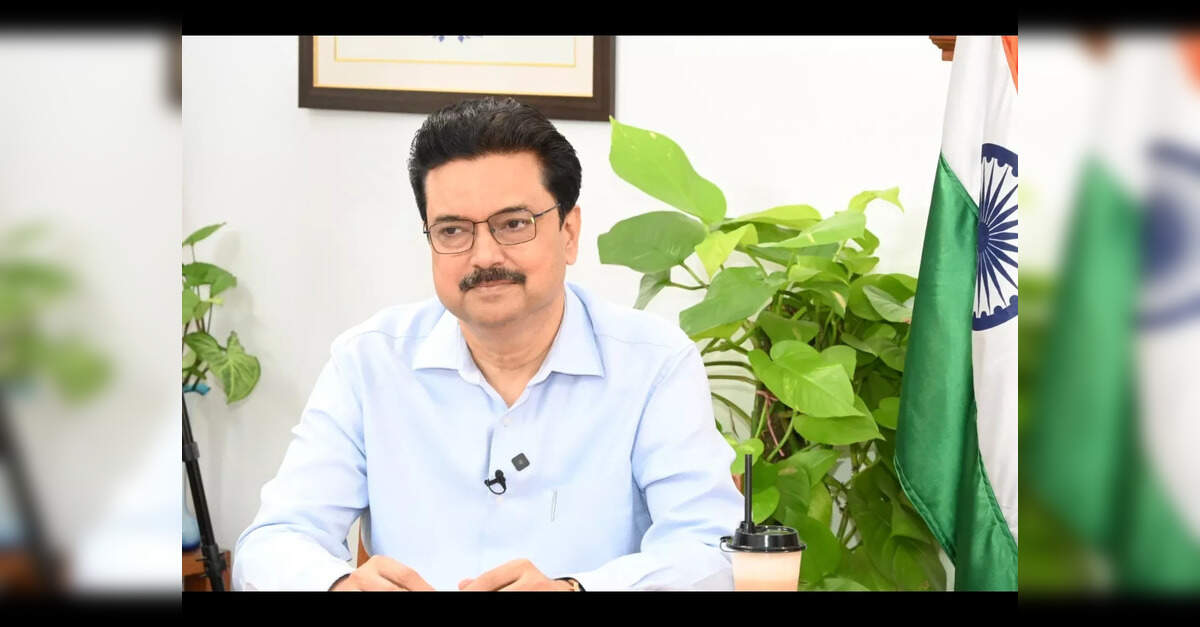
Prof Yogesh Singh, Delhi University VC and acting AICTE Chairman, during an exclusive conversation. In an exclusive conversation, Prof Yogesh Singh, Vice-Chancellor of University of Delhi and acting Chairman of All India Council for Technical Education, says the Common University Entrance Test (CUET) has significantly reshaped admissions by reducing over-representation and bringing greater diversity to classrooms, with more students from small towns and villages now entering Delhi University. He also discusses the rollout of the four-year undergraduate programme, the growing role of artificial intelligence in higher education, and why creativity and entrepreneurship are central to India’s journey towards a Viksit Bharat. Read the excerpts of the interview below:Q. You are currently leading two key institutions—Delhi University and AICTE. How do these roles complement each other?Prof Yogesh Singh: I am the Vice-Chancellor of the University of Delhi, and at AICTE I have been given additional charge since December 23, 2025. This is a temporary arrangement. AICTE is a regulator of technical education, while Delhi University is a full-spectrum university with a wide range of disciplines, including a Faculty of Technology. Technical education is extremely important for the growth and development of our country. If India has to lead, technology is the most appropriate instrument—whether for economic growth, job creation, or skill development. Delhi University, with around 6 lakh students, 86 teaching departments and nearly 90 colleges, plays a significant role in this ecosystem. Q. CUET has been positioned as a reform to address disparities in admissions. How do you see its impact, especially on diversity in classrooms? Prof Yogesh Singh: Until 2021, admissions were based on Class 12 marks, with different cut-offs across colleges and courses. India has multiple boards—CBSE, ICSE, and state boards—with different evaluation systems. Some are strict, some are lenient, and this created disparities. Students from stricter boards often found it difficult to secure admission. With CUET, introduced in 2022, a level playing field has been created. Students now get equal opportunity, and if someone does not perform well in one attempt, they can appear again the next year. There is, however, a flip side in terms of coaching. We have asked that the CUET question paper should be designed in such a way that a serious student of the NCERT curriculum is able to attempt the paper fully without needing coaching. The difficulty level should be reasonable so that every student can participate comfortably. At the same time, coaching institutions are offering CUET preparation and many students are joining them. But the advantages of CUET are significant. Earlier, there was over-representation from certain segments. CUET has addressed that. Those who perform better get equal opportunity.The composition of classrooms has changed. We now see representation from most states. Students from small towns and villages are joining Delhi University in larger numbers. It is a student-centric system that provides equal opportunity.Q. Delhi University had earlier implemented a four-year undergraduate programme. What is different this time and what has been the response so far?Prof Yogesh Singh: We are currently running the fourth year in some colleges, and about 30% of students have opted for it. It is research-based, project-oriented, and also linked to entrepreneurship. There are multiple tracks available for students. Those who complete the fourth year will also have the option of pursuing a one-year master’s programme in university departments.It is still early to draw conclusions, as the first batch has not graduated yet. Earlier, the programme could not continue due to various reasons. But now, under the National Education Policy, it has the support of all stakeholders. I see a very bright future for the four-year undergraduate programme. Q. NEP’s multiple entry-exit provision has been widely discussed. How does it benefit students in practical terms?Prof Yogesh Singh: If a student leaves after one year, they will receive a university certificate. Earlier, that year would have been a total loss. Now, credits are accumulated and preserved.Students can return after one, two, or three years and continue their education. They can also move to another institution. There is no loss of time or effort. This flexibility is particularly useful in real-life situations. For instance, if a student has to relocate, they can continue their studies elsewhere. While there are practical challenges, the provision itself is a positive step.Q. What must India get right in the next five years to achieve Viksit Bharat?Prof Yogesh Singh: We already have strong leadership. In education, we must focus on entrepreneurship, originality, and creativity. These are key.India has grown from a $1 trillion economy to around $4 trillion, and expectations are now to add $1 trillion every year. For this, we need creative, energetic, and committed citizens—engineers, doctors, professionals, and entrepreneurs. Higher education institutions must actively contribute. If all stakeholders work together, India will become a developed country. Q. What role does Delhi University play in this vision?Prof Yogesh Singh: Our role is very important because economic growth depends on the right kind of human resource. At Delhi University, we focus not only on education but also on values, ethics, and a sense of national responsibility through value-added courses.Q. How is AICTE approaching AI integration in education? Prof Yogesh Singh: AI is an opportunity; we should not be afraid of it. Whenever new technology comes, there is skepticism—this happened with electricity, computers, and the internet, and now with AI.We should learn AI tools and use them as assistants. AICTE has introduced specialised B.Tech and Master’s programmes in AI and is promoting AI and data science-related projects.This is an opportunity for India, and we should not miss it.Q. What initiatives has Delhi University taken in AI and data science?Prof Yogesh Singh: In the Faculty of Technology, we offer B.Tech programmes, and as minors we provide courses in AI, data science, and machine learning. These minors are also open to students from other disciplines.We also run an MBA in Data Science, which is quite popular. In addition, we are planning to start a four-year B.Sc. programme in Artificial Intelligence and Machine Learning.Q. What are the university’s expansion plans?Prof Yogesh Singh: Construction is underway at the East and South campuses. From the 2027–28 academic session, we plan to shift some departments and introduce new ones.Q. How do you ensure quality across such a large university system?Prof Yogesh Singh: Maintaining quality across a large system is always a challenge. Location plays a role, and colleges in remote areas require additional support.However, many of the top-ranked colleges in the country are part of Delhi University. Quality depends on both good teachers and bright students, and we are fortunate to have both.Q. Any message for students and teachers?Prof Yogesh Singh: I would like to request students and teachers to focus on economic growth, national welfare, and unity. Social harmony is essential for progress.We must create opportunities, especially in rural areas, and work towards reducing inequality. Students should aim not only to build their own careers but also to create opportunities for others.If students of Delhi University do not take responsibility for nation-building, then who will?
Published On Mar 19, 2026 at 12:58 PM IST
Join the community of 2M+ industry professionals.
Subscribe to Newsletter to get latest insights & analysis in your inbox.
All about ETEducation industry right on your smartphone!

 in democratizing access to higher education, and emphasizes the importance of creativity and entrepreneurship for India's development.)